
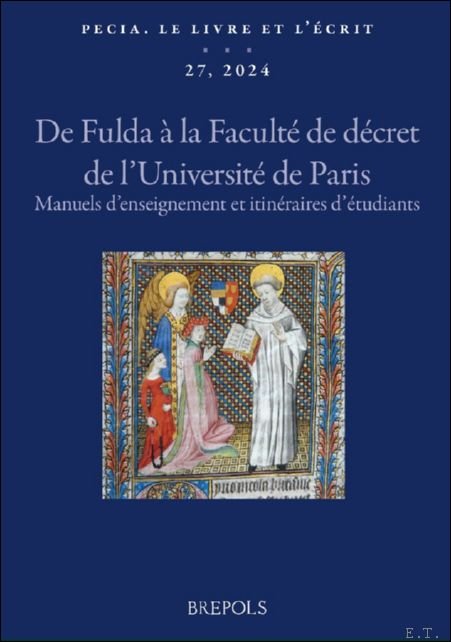
Collectif - Pecia. Le livre et l?écrit, 27 (2024, publ. 2025) D
| Schrijver: | Collectif |
|---|---|
| Titel: | Pecia. Le livre et l?écrit, 27 (2024, publ. 2025) De Fulda à la Faculté de décret de l'Université de Paris : manuels d?enseignement et itinéraires d'étudiants |
| Uitgever: | , Brepols - Harvey Miller, 2025 |
| Bijzonderheden: | Paperback, Pages: 290 p. Size:178 x 254 mm, Illustrations:24 b/w , Language(s):French, English, Italian. ISBN 9782503615776. |
| Prijs: | € 104,00 |
| Verzendkosten: | € 6,99 (binnen België) |
| Meer info: |
Summary In the Middle Ages, educational institutions played a fundamental role that extended well beyond the mere transmission of knowledge. Recent scholarship highlights how schools contributed to the structuring of social and religious life, notably through the regulation of time via calendars, liturgical observances, and communal rituals, thereby reinforcing collective identity. Male students, particularly in urban contexts, received instruction designed to prepare them for civic responsibilities, while female education ? though less institutionalized ? was nonetheless present, often delivered within domestic settings, monastic environments, or select schools. From the twelfth century onward, cathedral and monastic schools gradually gave rise to universities, structured around the liberal arts curriculum (trivium and quadrivium), with theology positioned as the apex of intellectual formation. Contemporary historians increasingly reassess these medieval educational systems in relation to modern concerns such as identity construction, knowledge accessibility, and the sociopolitical functions of schooling. Au Moyen Âge, les écoles jouaient un rôle essentiel, bien au-delà de la simple transmission de savoirs. Les recherches récentes montrent qu'elles structuraient la vie sociale et religieuse à travers l?organisation du temps scolaire (rythmes, fêtes, rituels) qui renforçait le sentiment d?appartenance communautaire. Les garçons, surtout dans les villes, recevaient une éducation visant à former des citoyens responsables, tandis que les filles, bien que moins souvent scolarisées, accédaient tout de même à une forme d?instruction via la famille, les monastères ou certaines écoles. À partir du xii? siècle, les écoles cathédrales et monastiques évoluent en universités organisées autour des arts libéraux (trivium et quadrivium), avec la théologie comme sommet du cursus. Aujourd?hui, les historiens réévaluent ces structures éducatives médiévales à la lumière de questions contemporaines, comme la formation des identités collectives, l?accès au savoir et le rôle des institutions scolaires dans la société. TABLE OF CONTENTS Oliver, Eduard, O.S.B., In fulda dogma sacrum didici: Hrabanus Maurus, and the Anglo-Saxon Exegetical Tradition Cataldi, Claudio, The School of Abingdon in Early Medieval England Fredette, Anthony ? Whedbee, Simon, Prolegomena to an Edition of a Twelfth-century Commentary on the Georgics Attributed to Hilarius of Orléans Ingegno, Maria Valeria, La virtù della caritas e le sue implicazioni nella riflessione di Gilberto di Poitiers (1 Cor. 12, 31?13,13): dall?habitus humilitatis alla visione di Dio Weijers, Olga, Les gloses comme témoins de l'enseignement à la Faculté des arts Bassano, Marie, L?âge d?or d?avant l?Université : Le studium juridique orléanais au XIIIe siècle Courtenay, William J. ? Sullivan, Thomas, Pre-Theological Education at Paris for Monastic Students in the Fourteenth Century Deuffic, Jean-Luc, Et en vérité, des plus grans clercs du monde ont leu du matin ? À propos de Guillaume Chalop, un maître breton moult suffisant Sullivan, Thomas, Ranking and Adoption in the Licentiate Program of the Parisan Faculty of Canon Law, 1416?1448 Spychala, Pauline, Première étape ou couronnement de parcours ? L?Université de Paris dans le cursus des étudiants étrangers à la fin du Moyen Âge Bernard-Schweitzer, Marion, Les collèges normands à Paris aux XIVe et XVe siècle
|


De verkoper zal binnen 3 werkdagen contact met u opnemen om de koop verder af te handelen.
Afbeeldingen (Klik om te vergroten)
Het huisnummer is ook opgegeven in het straat veld. Gelieve controleren of de velden straat en huisnummer correct zijn opgegeven.
Straat:
Nummer:
- Alle boeken zijn compleet en verkeren in normale antiquarische staat, tenzij anders beschreven. Kleine onvolkomenheden, zoals een ingeplakte ex-libris of een naam op het schutblad, zijn niet altijd vermeld
- U handelt deze order direct af met Erik Tonen Books
Dit boekwinkeltje is een zakelijke verkoper. Hierdoor heeft u o.a. herroepingsrecht waarmee u het boek binnen 14 dagen na ontvangst retour kunt sturen. Verder lezen. - Na uw bestelling ontvangen u en Erik Tonen Books een bevestiging per e-mail. In de e-mail staan de naam, adres, woonplaats en telefoonnummer van Erik Tonen Books vermeld
- De Koper betaalt de verzendkosten, tenzij anders overeen gekomen
- Erik Tonen Books kan betaling vooraf vragen
- Boekwinkeltjes.nl probeert Kopers en Verkopers tot elkaar te brengen. Boekwinkeltjes.nl is echter nimmer partij bij een overeenkomst die gesloten wordt tussen Koper en Verkoper door gebruikmaking van de site. Als u een geschil hebt met één of meer gebruikers, dient u dit zelf op te lossen. U vrijwaart Boekwinkeltjes.nl van enigerlei vorderingen, aanspraken op schadevergoeding en dergelijke, verband houdende met dergelijke geschillen.
Onthoud mijn gegevens
Registreer u vrijblijvend als koper!
Besteld, hoe nu verder?
De verkoper zal binnen 3 werkdagen contact met u opnemen om de koop verder af te handelen. Afhankelijk van uw locatie heeft u in de meeste gevallen binnen 2 dagen uw bestelling in huis.