
Stel een vraag
Met het formulier hier onder kunt u contact op nemen met boekwinkel De Slegte.
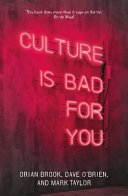
Orian Brook, Dave O'Brien, Mark Taylor - Culture is Bad for You
De vraag gaat over de volgende titel:
| Afbeelding: |
|
|---|---|
| Schrijver: | Orian Brook, Dave O'Brien, Mark Taylor |
| Titel: | Culture is Bad for You |
| ISBN: | 9781526144164 |
| Uitgever: | Manchester University Press |
| Bijzonderheid: | Goed, 2020, Paperback, 361p |
| Prijs: |
€ 11,00
€ 3,50
|
| Meer info | 1 Introduction Culture is good foryou. Culturewill help keep you fit and healthy. Culture will bring communities together.Culture will improve your education1 and get you higher wages during your career.2 Culturewill transform your village, town, or city for the better.3 Culture is what makes countries successful. This is the messagefrom gov- ernments, 4 aswell as from arts and cultural organisations.5 Culture is an essential part of most people's lives.6 Culture is watching a gripping television show orgetting absorbed in the world of avideo game. It is reading a book or writing a poem, going to see a band, discussing a film with friends. Culture is singing in a choir, acting on stage, or crafting a gift for the family.These activities are just a few examples of culture. Culture captures what people make, what they participate in, and what they attend. Cultureis a central part of what it means to be human. This book explains why we need to be cautious about culture. We will demonstrate that culture is closely relatedto inequality in society. Who produces culturereflects social inequality. The work- force in cultural occupations and culturalindustries is highly unequal.7 To 'make it' in a cultural job you need the sort of eco- nomic, social, and cultural resourcesthat are not fairly shared within society.8 Who consumes culturereflects social inequality.9 The audi- ence attending artforms including theatre, classical music, opera, ballet, jazz, and exhibitions is a minority of the population.10 Participation has similar patterns. Painting, playing instru- ments, singing, dancing, writing, and performing are only done by a minority of the population. The way we defineculture reflects social inequality. What countsas culture, and what is excluded from the definition, is a site of long-standing debate.11 We know aboutattendance and participation from gov- ernment surveys. These surveys contrasteveryday activities, such as shopping, DIY, and listening to music, with formalcultural activity, such as attending a theatre or participatingin a choir.12 Decisions in survey methodsreflect that some cultural forms are given high socialstatus, with considerable state funding and support. Other cultural forms are thepreserve of commer- cial and community organisations. Whatcounts as 'high' and 'everyday' culture reflects historical struggles over legitimacy.13 What counts also reflects social inequalitiesassociated with class, race, and gender. These are just a few introductory examples of the relation- ship between culture andinequality. If producing, consuming, and even defining, culture is closely related to inequality, perhaps we shouldbe asking whether culture is bad for you. Henna'sstory Tostart to understand the relationship between inequality and culture we can hear from Henna.Henna was one of 237 creativeandcultural workers we interviewed for the research and analysispresented in this book. Like the rest of our participants we've given her a pseudonym, so she could be honest and open in the interview. We were asking her about her career, and workinglife. Henna was in her early thirties at the time of the interview. She isa South Asian woman from a middle-class background, living in London and working in film and television. As well as her middle-class origin, she had adegree from a very presti- gious university. Tothe outsider's eye she had every possible advantage to 'make it' in her chosen culturalcareer. Yet she was bluntabout the reality of workinglife: The UK film industry is not a meritocracy at all. It doesn't matter ifyou're intelligent or well-qualified or any of those things.What matters is who you know and who you've worked with. It's alsomassively to do with being a woman of colour... They would much rather hire the White dude, and they feel more comfort- ablewith the White dude, than the bolshy brown woman who seems to have done things that they don'tfeel comfortable with. Ofcourse. That's just the reality of it. Henna tells us some of our reasons why we've written this book, and why we've given it the provocative title of Culture is bad for you. She gives us the startingpoint for why we should questionsome of the 'good news' aboutculture. Hennawas a successful filmmaker, with an international reputation. She was candidand blunt abouther experiences in hercultural occupation. She reflected on the reasons that, despite her obvioustalent and track record, she had not hit the same heights as some of her contemporaries. 'Who you know and who you've worked with' arehow the labour market in film functions. The industry is risk-averse as aresult of the huge costs of production (and of subsequent dis- tribution and marketing), set against the uncertainty of success.The issue of risk in the film industryis reflected in other cul- tural occupations. We may know a great deal aboutaudience tastes, but we can neverreally be sure of what will be a hit. It is hardto be sure if investment in developing a new artist, a new musician, a new play, or a new novel will pay off.14 We wouldonly get part of the explanation for Henna's frus- tration if we focused on how thelabour market functions.15 Finding it difficultbecause of not knowing the right people, of not having key networks and social resources, is understandable in a field with very fast schedules.Time, in film as in many other industries, is money. This wasn't all thatHenna told us. She told us her gender, and the colour of her skin, were given less value than those of her White, male colleagues. This was despite the claims by parts of the film industry, and by government policy, that film is open to any and all who are talented.16 This book tells thestory of Henna's observation thatfilm, and much of the rest of culture, is not a meritocracy. It is notenough to be talented and hard-working to make it. We will see how theworkforce in cultural occupations is deeply unequal, with class, race, andgender constituting crucial axes of inequality. Film and television occupations are hostile to women; museums, galleries, and librariesare markedby their Whiteness. Publishing is 'posh'. The 'posh- ness' of specific culturaloccupations, the absence of those from working-class origins, is not a newthing. It is a long- standing problem. Inequalities in who works in culturaloccupations are driven by several factors. Low and no payare crucial in excluding those without financialresources from enteringcultural jobs. At key points in careers, women facehidden, and not so hidden, discrimination. Childhood engagement in culture isimportant in getting a cultural career later in life. There are significantinequalities as people grow up. In many occupations the defaultimage of a cultural worker, as Hennapoints out, is a White man from a middle-class background. People who are notpart of that demographic group face substantial barriers to their success. These are someexamples of the dynamics that shapethe sorts of culture we get. Theyshape the audience too. We will demonstrate how cultural consumption is highlyunequal. Wesometimes think of culture as opento all. Government policy has made some museumsfree, and subsidised the cost of other artforms. Our analysis shows thatengagement in many forms of government-supported cultureare, at best, a minority concern. This is true whether we look at ticket sales or we surveypeople about what they attend. Cultural productionand cultural consumption are the two areas of focus for our story about culture and inequality. These two areas have seen a long-standingand rich set of research traditionsand agendas associated with them.17 We're con- tributing new data and new analysisto this already extensive academic work. The Panic! project and partnership Much of the new data and new analysiscomes from two research projects. These were conducted by several aca- demics, alongwith partners from the culturalsector. The focus ofmuch of this work was raisingawareness of what existing academicresearch was telling us about culture and inequality. In 2015 Create London wanted to understand what they felt was a crisis for social mobility inthe arts. Create's initial set of ideascreated a research partnership. This brought Drs Sam Friedman, Daniel Laurison, Dave O'Brien, and MarkTaylor, along with support from Goldsmiths College, together with Create Londonand Barbican.18 In the 2018 version Mark and Dave were joinedby Dr Orian Brook, and Arts Emergency became a core partnerwith Barbican and Create London.19 We were also lucky to work alongwith Drs Sara De Benedictis and Jordan Tchilingirian, Nikki Kane, and Bozena Wielgoszewska. The 2015 project workedwith the Guardian to survey cul- tural workers about their careers, as well as their values and attitudes. With help from trade unions and key individuals on social mediawe gathered 2,487responses to that survey. Wethen conducted interviews with 237 of those respond- ents, probing furtherelements of their cultural work andtheir cultural lives. We also used the interviews to double-check some of our survey findings.20 Thesurvey and the interview fieldwork yielded massive amounts of fascinating data. The 2018 Panic! projectreported on some of the findings.21 It also allowed us to do more analysis of nationally representative datasets. Using Census data anddata from the government's Taking Part survey, which covers culturalactivity in England, we were ableto report new findings about culture and inequality. We also drew on work withother academic collaborators, 22 pre- sentingfindings from the Labour ForceSurvey and from BritishSocial Attitudes, and British ElectionStudy survey data, as well as the original Panic! surveydata.23 These elements were brought together in theindustry and public facing report: Pan |
| Boek bekijken | |

De verkoper zal binnen 3 werkdagen contact met u opnemen om de koop verder af te handelen.